Career / Entry №200 / Merch
HOW TO SET UP A MERCH TABLE THAT ACTUALLY PULLS PEOPLE IN
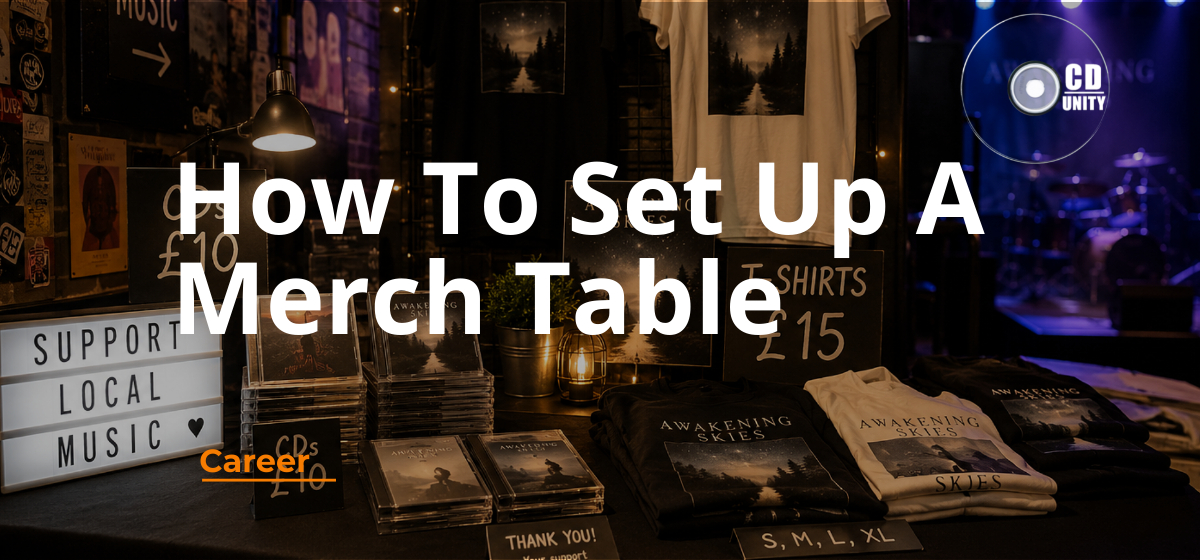
You can play the best set of your life, walk off to actual applause, and still watch every single person head for the door past a stand nobody looked at twice. I’ve seen it from behind the stock, and I’ve seen it happen to acts I genuinely rate.
This is about fixing that, and it costs almost nothing. Not a bigger budget, not more stock. Just height, light, clear numbers, and where you choose to stand.
I’m a graphic designer by trade, so I look at a merch table the way I’d look at an album cover: composition, contrast, and whether your eye knows where to land first. The rest of what follows comes from talking to bands every week at CD Unity, and from a fair few nights stood behind a wobbly trestle with a tin of change and a hopeful expression.
Key Takeaways
- Height beats width. Two crates or a pair of storage cubes lift your stock into eye line and make the whole display look deliberate rather than dumped.
- Bring your own lamp. Most rooms point everything at the stage and forget the rest. A battery lamp is the single biggest instant upgrade available to you.
- Put a number on everything. Nobody wants to ask what things cost, and the person who won’t ask is the person who leaves empty-handed.
- Cheap things do the heavy lifting. Stickers and a £3 impulse buy give people a way in, and once somebody has bought something small the £25 thing feels easy.
- Someone has to stand there. A mate, your guitarist between sets, or an actual merch manager on longer runs. An unattended table sells close to nothing.
- Collect emails, not just cash. A sign-up sheet is worth more over a year than the stock you shift on the night.
Most people who walk past aren’t rejecting your music. They’re avoiding an awkward moment with a stranger in the darkest corner of the room while their mates are already outside having a smoke. Once you see it that way, the fixes stop being about persuasion and start being about removing friction.
Three things stop somebody coming over: they can’t see what’s there, they don’t know what it costs, and they’re not sure whether they’ll be trapped in a conversation. Sort those three and you’ll get people stopping who would otherwise have walked away.
Selling merch at a gig isn’t really retail, and it helps to stop thinking of it that way. People don’t buy merch because they need another cotton item in a drawer. They buy merch because they want a piece of the night to take home, and because your name will stick in their head far longer if there’s an object attached to it. That’s a completely different conversation to the one a shop has.
The opposite mistake is just as common as being invisible. Forty different things spread across one surface makes people freeze, and too much choice will overwhelm a tired audience at half eleven at night. A frozen buyer says “maybe on the way out” and then goes home. If you want the fuller version of that thinking, our guide to shifting more stock at gigs covers the pricing side in more depth.
From what I see come through CD Unity, the artists who do best on the night are the ones who narrowed it right down. One design. One record. One cheap thing. Done properly.
You don’t need a flight case and a lighting rig. A portable kit that one person can carry in two trips is worth far more than a beautiful build you’re too knackered to bother with on the fifth night of a run.
Here’s the must-have list, and it genuinely is this short:
- A folding table, if the room doesn’t provide one. Most do. Not all.
- A dark cloth to hide whatever state the surface is in.
- Two or three wooden crates or storage cubes to build height at the back.
- A battery lamp or a clip-on reading lamp.
- A banner you can hang behind you, or bulldog-clip to the front.
- A cash tin, a card reader, and a pen that works.
The whole lot should pack down into one crate and a bag. If it doesn’t, you’ll skip it on the night the gear needs loading out in the rain, and that’s usually the night you’d have sold the most.
A DIY build is completely fine, by the way. I’ve seen a killer setup made from a wallpapering table, two milk crates and a bedsheet, and it read better across a room than plenty of expensive ones, because somebody had actually thought about how it looked from a distance. Pick the kit that suits the rooms you’re playing now, not the rooms you’d like to be playing in three years.
Lighting is the thing almost nobody does, and it changes more than anything else on this list. Venues aim everything at the stage. Where you’re standing is usually the dimmest part of the building, which is why your carefully designed sleeve reads as a grey rectangle from two metres away.
One warm lamp angled down at the stock turns a dead corner into somewhere that looks open for business. Battery powered, so you’re not hunting for a plug socket behind a fridge.
Height is the other half of it. Flat is invisible. Crates under the back row, so the top of your stock sits near chest height, means people can see your merch from the bar. That matters, because the bar is where the decision actually gets made, long before anyone walks over.
Then treat the whole thing as a poster. One focal point, a clear hierarchy, and repetition where you can get it. Fold your t-shirts so the artwork faces out instead of the collar, stand records up rather than laying them flat, and leave gaps between groups. Space reads as confidence. Clutter reads as a car boot sale.
If your artwork isn’t doing that job yet, that’s a design problem rather than a display problem, and it’s the part I spend my working life on. Our graphic design service exists for exactly that, and it’s also worth reading how to brand yourself as a musician if the look of everything feels a bit scattered.
— A free CD sample —ECO CDS YOURSELF
Range matters less than the ladder. You want something around £2, something around £10, and something around £25. Stickers and badges at the bottom, a t-shirt or a record at the top, and one option in the middle that feels like a small treat rather than a decision.
A price list, in big type, on a stand, is the cheapest single fix on this page. It answers the question people are least willing to ask out loud, and it stops whoever’s covering for you inventing prices at midnight. If you’re not sure what the numbers should be, here’s what to charge for a CD at a gig.
Physical stock is the part I know best, sitting where I sit. Vinyl looks incredible standing upright but it’s heavy and it hates a hot room. Card sleeve CDs are lighter to carry, cheap to run in short quantities, and they still feel like a real object in somebody’s hands, which is the entire point of the exercise. A run of 100 costs far less than most bands expect it to.
Bundles work better than discounts. A record and a shirt together for five pounds less than the two bought separately moves more than knocking a fiver off either on its own. And every merch item you carry should earn its space in the van: if it hasn’t shifted in three shows, it stays at home next time.
Tote bags are the quiet winner, incidentally. Cheap to produce, easy to pack flat, and people genuinely use them, which means somebody is carrying a piece of your merch around town for the next two years without you paying a penny for it.
Lock today’s price.
Press CDs in 12 months.
Most artists aren’t ready to press the day they finish a song. Lock today’s CD bundle prices and use them anytime in the next 12 months.
Stand beside your stock, not behind it. Behind is a counter. Beside is a conversation. It sounds like nothing and it changes the entire dynamic of the next thirty seconds.
If you’re shy, and plenty of musicians are, give yourself one line and say it beforehand in the van until it stops feeling strange. “Thanks for coming, we’ve got records and merch here if you fancy something.” That’s the whole script. You’re not closing a deal.
The fastest way to spark a conversation is to give something away before anybody reaches for a wallet. A download card, a badge, anything that means the first interaction isn’t a transaction. And nobody will approach two people staring at their phones, so put the phones face down.
People come over after a gig for a reason, and it usually isn’t the shirt. They want to say the thing they’ve been rehearsing in their head since the third song. Let them say it. The purchase is almost always a by-product of that thirty seconds, not the aim of it.
Ask for the email while you’re there. A clipboard and a pen beats an Instagram follow every time, because you own the list and nobody’s algorithm gets a vote on whether your next announcement lands.
The trick that works best, and I’ve watched a couple of the bands we press for do this properly, is to write the set list out on a card and hand it over with anything anyone buys. Costs nothing. Takes ten seconds. Makes the whole thing feel like a memento rather than a purchase.
A decent night on the band’s merch can bring in more revenue than the door split, especially on a support slot, provided the venue isn’t taking a cut of it. The FAC’s 100% Venues directory lists the UK rooms that don’t. That’s not a small detail when you’re working out whether the next run of shows is affordable.
Growing this is mostly about people rather than kit. The jump from a table in the corner to a proper booth happens the moment somebody’s only job is standing there, because it means the booth is open during the support acts and not just for eleven rushed minutes at the end of the night.
Track it, too. Write down what shifted each night and where, and you’ll know which cities to prioritise on the next tour. Merch table sales are the clearest read you’ll ever get on where your fans actually are, and they’re a good deal more honest than streaming maps.
That’s the point to upgrade your merch properly: a printed cloth, a light bar, a rack that holds records upright, maybe a second surface so two people can be served at once. Do it in roughly that order, and pay for it out of money the stock has already made rather than money you’re hoping it will.
Plenty of the bands I speak to find that merch sales cover the fuel and the accommodation for a short run of live shows, which is the difference between touring being a hobby and touring being something you can keep doing. That’s a real boost when you’re scraping the money together yourself. Every podcast about life on the road eventually lands on the same point: at this level, the money is in the room, not on the platforms.
For inspiration, watch what the support act does at the next decent live music venue you’re in. The good ones are set up before doors, with a lamp on, somebody standing there, and clear numbers on everything. It isn’t a secret. It’s just effort applied early, and it pairs neatly with the rest of your launch plan in our release day checklist.
Frequently Asked Questions
What if the venue doesn’t provide a table?
Ask when you’re confirming the show, because it’s an easy yes and a horrible surprise. If the answer is no, a 4ft trestle from any hardware shop fits in most car boots and costs about £30. Failing that, I’ve watched more than one act get through a night with an ironing board and a dark cloth, and honestly nobody noticed.
How much stock should we bring to a single show?
Rough guide from what I’ve seen: expect somewhere between 5% and 15% of the room to buy something on a decent night. For 100 people that’s 5 to 15 items, so hauling 40 of anything is just carrying weight for the sake of it. Bring depth on the cheap thing and shallow numbers on the expensive one.
Do we need a card reader?
Yes. Cash-only costs you money every single night, and it costs you more every year as fewer people carry notes. A reader is around £30 and pays for itself the first time somebody says they’ve got nothing on them. Keep a small float as well, because there’s always one person with a £20 note.
What’s the one thing you’d fix first?
A lamp. Then height. Then numbers on everything. In that order. It’s the cheapest sequence of improvements available to a musician, the total spend is under £50, and the difference shows up on the first night you do it. Everything after those three is refinement.
Any tips for festival stages or multi-band bills?
Get there early, because the good spot goes fast and it’s usually nearer the bar than the stage. Keep everything compact so you can share a surface without falling out with anyone. Take a photo of the finished setup for Instagram before a single person touches it, because that’s free promotion and it gives new fans a look at what you make. And somebody’s guitar case will end up parked in front of your stock at some point. Move it.

Hello, I’m Josh, and I’ve been honing my graphic design skills for almost 15 years now, catering to the needs of bands and businesses alike. What really fascinates me is the business aspect of the music industry. In addition to my design work, I also happen to play the Hammond organ, and I strive to share my knowledge through helpful articles that I write exclusively for you all!